sexta-feira, 29 de março de 2013

Ozônio no tratamento de Úlceras, Infecções, Gengivas, Diabete, Virus, Bactérias.....

OZONE 


Medicina Complementar
Dicas para sua saúde integral

Entenda o funcionamento, aplicação e benefícios da ozonioterapia
por Alex Botsaris
A ozonioterapia é o tratamento feito com a utilização de ozônio, um gás formado por três átomos de oxigênio. Ele foi descoberto em 1840 por Schönbein, ao expor oxigênio a descargas elétricas. A ozonioterapia foi descoberta pelo Dr. Erwin Payr, médico e professor de cirurgia na Universidade de Leipzig, na Alemanha, que escreveu um trabalho intitulado "O tratamento com ozônio na cirurgia".
"A ozonioterapia tem mais evidência científica no tratamento de úlceras crônicas, em especial em pacientes diabéticos"Payr havia visto seu dentista usar ozônio para desinfetar as cavidades dentárias nos seus tratamentos e teve a idéia de usá-lo para reduzir a incidência de infecção no pós-operatório; um problema nesse tempo quando os antibióticos ainda não estavam disponíveis.
Sua conclusão foi que o ozônio auxiliava na prevenção de infecção. Nessa época já se conhecia o poder antimicrobiano do ozônio, mas o método ficou restrito a médicos alemães e austríacos.
A ozonioterapia ficou esquecida por muitos anos e só começou a ser mais falada e investigada a partir do surgimento da medicina ortomolecular, porque se descobriu que o ozônio é um potente estimulante dos sistemas antioxidantes endógenos, e tem potencial para prevenir várias doenças degenerativas que se caracterizam por uma atividade oxidativa elevada.
A ozonioterapia foi trazida para o Brasil na década de 1970 pelo médico Heinz Konrad, que até hoje aplica, e é um grande entusiasta do método. Para se fazer a ozonioterapia é necessário um aparelho de ozônio medicinal, que prepara misturas específicas de oxigênio e ozônio que são as preconizadas para fins terapêuticos.

Benefícios do ozônio
Além de estimular os sistemas antioxidantes endógenos o ozônio tem vários outros efeitos interessantes. Ele é um potente vasodilatador e melhora a curva de dissociação da hemoglobina com o oxigênio, melhorando a oxigenação tecidual, ele estimula a liberação de mediadores da imunidade como os interferons e citocinas, e também tem efeito direto sobre diversos agentes infecciosos como vírus, bactérias e fungos.
A ozonioterapia tem mais evidência científica no tratamento de úlceras crônicas, em especial em pacientes diabéticos, e no tratamento do *pé diabético. Além de alguns estudos clínicos comprovando esses resultados, a melhora é tão rápida e evidente, numa doença de prognóstico ruim, que já poderia estar num patamar mais validado e acessível para uso dos pacientes. Assim seu uso tem mostrado resultados também em outros problemas das artérias, como insuficiência vascular periférica e acidentes vasculares encefálicos do tipo isquêmico.
Os efeitos viricidas do ozônio são particularmente potentes sobre os vírus da hepatite B e C, e sobre o vírus herpes. Por isso seu emprego, ainda experimental tem sido feito em herpes zoster, herpes simples de repetição ou no tratamento de hepatites crônicas quando o tratamento convencional falhou e o paciente está evoluindo de forma desfavorável. Ainda são passíveis de ter resultados usando a ozonioterapia como tratamento adicional de suporte a síndrome da fadiga crônica, colites inespecíficas, osteomielite e outras infecções crônicas que estão respondendo mal aos antimicrobianos, e portadores de retinopaia diabética ou degeneração macular senil.
*Pé diabético: pequenas lesões nos pés de diabéticos que evoluem com infecção e necrose, em geral leva à amputação de parte da perna.

OZONE LAYER DEPLETION

OZONE
Ozone 3045 
Ozone is an allotrope (a physically or chemically different form of the same substance) of oxygen with the chemical formula O 3 . This formula shows that each molecule of ozone consists of three atoms. By comparison, normal atmospheric oxygen—also known as dioxygen—consists of two atoms per molecule and has the chemical formula O 2 .
Ozone is a bluish gas with a sharp odor that decomposes readily to produce dioxygen. Its normal boiling point is −112°C (−170°F), and its freezing point is −192°C (−314°F). It is more soluble in water than dioxygen and also much more reactive. Ozone occurs in the lower atmosphere in very low concentrations, but it is present in significantly higher concentrations in the upper atmosphere. The reason for this difference is that energy from the Sun causes the decomposition of oxygen molecules in the upper atmosphere:
O 2 → (solar energy) → 2O
The nascent (single-atom) oxygen formed is very reactive. It may combine with other molecules of dioxygen to form ozone:
O + O 2 → O 3

Words to Know

Allotropes: Forms of a chemical element with different physical and chemical properties.
Chlorofluorocarbons (CFCs): A family of chemical compounds consisting of carbon, fluorine, and chlorine.
Dioxygen: The name sometimes used for ordinary atmospheric oxygen with the chemical formula O 2 .
Electromagnetic radiation: A form of energy carried by waves.
Nascent oxygen: Oxygen that consists of molecules made of a single oxygen atom, O.
Ozone hole: A term invented to describe a region of very low ozone concentration above the Antarctic that appears and disappears with each austral (Southern Hemisphere) summer.
Ozone layer: A region of the stratosphere in which the concentration of ozone is relatively high.
Radiation: Energy transmitted in the form of electromagnetic waves or subatomic particles.
Standard (pollution): The highest level of a harmful substance that can be present without a serious possibility of damaging plant or animal life.
Stratosphere: The region of Earth's atmosphere ranging between about 15 and 50 kilometers (9 and 30 miles) above Earth's surface.
Troposphere: The lowest layer of Earth's atmosphere, ranging to an altitude of about 15 kilometers (9 miles) above Earth's surface.
Ultraviolet radiation: A form of electromagnetic radiation with wavelengths just less than those of visible light (4 to 400 nanometers, or billionths of a meter).

Ozone layer depletion

Most of the ozone in our atmosphere is concentrated in a region of the stratosphere between 15 and 30 kilometers (9 and 18 miles) above Earth's surface. The total amount of ozone in this band is actually relatively small. If it were all transported to Earth's surface, it would form a layer no more than 3 millimeters (about 0.1 inch) thick. Yet stratospheric ozone serves an invaluable function to life on Earth.
Radiation from the Sun that reaches Earth's outer atmosphere consists of a whole range of electromagnetic radiation: cosmic rays, gamma rays, ultraviolet radiation, infrared radiation, and visible light. Various forms of radiation can have both beneficial and harmful effects. Ultraviolet radiation, for example, is known to affect the growth of certain kinds of plants, to cause eye damage in animals, to disrupt the function of DNA (the genetic material in an organism), and to cause skin cancer in humans.
Fortunately for living things on Earth, ozone molecules absorb radiation in the ultraviolet region. Thus, the ozone layer in the stratosphere protects plants and animals on Earth's surface from most of these dangerous effects.
Human effects on the ozone layer. In 1984, scientists reported that the ozone layer above the Antarctic appeared to be thinning. In fact, the amount of ozone dropped to such a low level that the term "hole" was used to describe the condition. The hole was a circular area above the Antarctic in which ozone had virtually disappeared. In succeeding years, that hole reappeared with the onset of each summer season in the Antarctic (September through December).
The potential threat to humans (and other organisms) was obvious. Increased exposure to ultraviolet radiation because of a thinner ozone layer would almost certainly mean higher rates of skin cancer. Other medical problems were also possible.
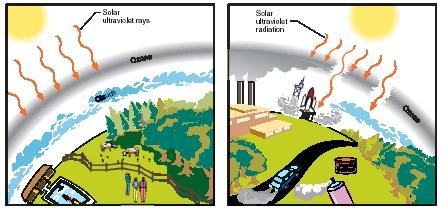
An atmosphere with a relatively intact ozone layer (left) compared to one with an ozone layer damaged by chlorofluorocarbon (CFC) emissions. (Reproduced by permission of The Gale Group.)
An atmosphere with a relatively intact ozone layer (left) compared to one with an ozone layer damaged by chlorofluorocarbon (CFC) emissions. (Reproduced by permission of
The Gale Group
.)
At first, scientists disagreed as to the cause of the thinning ozone layer. Eventually, however, the evidence seemed to suggest that chemicals produced and made by humans might be causing the destruction of the ozone. In particular, a group of compounds known as the chlorofluorocarbons (CFCs) were suspected. These compounds had become widely popular in the 1970s and 1980s for a number of applications, including as chemicals used in refrigeration, as propellants in aerosol sprays, as blowing agents in the manufacture of plastic foams and insulation, as drycleaning fluids, and as cleaning agents for electronic components.
One reason for the popularity of the CFCs was their stability. They normally do not break down when used on Earth's surface. In the upper atmosphere, however, the situation changes. Evidence suggests that CFCs break down to release chlorine atoms which, in turn, attack and destroy ozone molecules:
CFC → solar energy → Cl atoms
Cl + O 3 → ClO + O 2
This process is especially troublesome because one of the products of the reaction, chlorine monoxide (ClO) reacts with other molecules of the same kind to generate more chlorine atoms:
ClO + ClO → Cl + Cl + O 2
Once CFCs get into the stratosphere and break down, therefore, a continuous supply of chlorine atoms is assured. And those chlorine atoms destroy ozone molecules.
Scientists and nonscientists alike soon became concerned about the role of CFCs in the depletion of stratospheric ozone. A movement then developed to reduce and/or ban the use of these chemicals. In 1987, a conference sponsored by the United Nations Environment Programme resulted in the so-called Montreal Protocol. The Protocol set specific time limits for the phasing out of both the production and use of CFCs. Only three years later, concern had become so great that the Protocol deadlines were actually moved up. One hundred and sixty-five nations signed this agreement. Because of the Protocol, the United States, Australia, and other developed countries have completely phased out the production of CFCs. According to the Protocol, developing nations have until the year 2010 to complete their phase out.

Ozone in the troposphere

Ozone is a classic example of a chemical that is both helpful and harmful. In the stratosphere, of course, it is essential in protecting plants and animals on Earth's surface from damage by ultraviolet radiation. But in the lower regions of the atmosphere, near Earth's surface, the story is very different.
The primary source of ozone on Earth is the internal-combustion engine. Gases released from the tailpipe of a car or truck can be oxidized in the presence of sunlight to produce ozone. Ozone itself has harmful effects on both plants and animals. In humans and other animals, the gas irritates and damages membranes of the respiratory system and eyes. It can also induce asthma. Sensitive people are affected at concentrations that commonly occur on an average city street during rush-hour traffic.
Ozone exposure also brings on substantial damage to both agricultural and wild plants. Its primary effect is to produce a distinctive injury that reduces the area of foliage on which photosynthesis can occur. (Photosynthesis is a complicated process in which plants utilize light energy to form carbohydrates and release oxygen as a by-product.) Most plants are seriously injured by a two- to four-hour exposure to high levels of ozone. But long-term exposures to even low levels of the gas can cause decreases in growth. Large differences among plants exist, with tobacco, spinach, and conifer trees being especially sensitive.
Many nations, states, and cities have now set standards for maximum permissible concentrations of ozone in their air. At the present time in the United States, the standard is 120 ppb (parts per billion). That number had been raised from 80 ppb in 1979 because many urban areas could not meet the lower standard. Areas in which ozone pollution is most severe—such as Los Angeles, California—cannot meet even the higher standard. Measurements of 500 ppb for periods of one hour in Los Angeles are not uncommon.

Long-term problem

Despite a relatively rapid and effective international response to CFC emissions, the recovery of the ozone layer may take up to 50 years or more. This is because these chemicals are very persistent in the environment: CFCs already present will also be around for many decades. Moreover, there will continue to be substantial emissions of CFCs for years after their manufacture, and uses are banned because older CFC-containing equipment and products already in use continue to release these chemicals.
In studies released in late 2000, scientists said they were stunned by findings that up to 70 percent of the ozone layer over the North Pole has been lost and that the ozone hole over the South Pole grew to an expanse larger than North America. According to the National Oceanic and Atmospheric Administration (NOAA), the hole in the ozone layer over the South Pole expanded to a record 17.1 million square miles (44.3 million square kilometers).
Scientists blamed the record ozone holes on two main reasons: extreme cold and the continued use of bromine. Recent very cold winters in the two poles have slowed the recovery of the ozone layer. Cold air slows the dissipation and decay of CFCs, which allows them to destroy ozone faster. Bromine is a chemical cousin to chlorine and is used for some of the same purposes—fire fighting, infection control, and sanitation. NOAA believes bromine is 45 times more damaging to ozone in the atmosphere than chlorine. But bromine has not been regulated as strictly as chlorine because countries could not stand the loss of income if it were regulated more. Some scientists, however, believe governments will be under growing pressure in the coming years to limit the chemical.

Ozone Depletion

OZONE
www.ozone.br.vu

Ozone Hole


THE OZONE HOLE


Ozone Creation
One billion years ago, early aquatic organisms called blue-green algae began using energy from the Sun to split molecules of H2O and CO2 and recombine them into organic compounds and molecular oxygen (O2). 
This solar energy conversion process is known as photosynthesis. 
Some of the photosynthetically created oxygen combined with organic carbon to recreate CO2 molecules. The remaining oxygen accumulated in the atmosphere, touching off a massive ecological disaster with respect to early existing anaerobic organisms. As oxygen in the atmosphere increased, CO2 decreased.
NASA Goddard DAAC

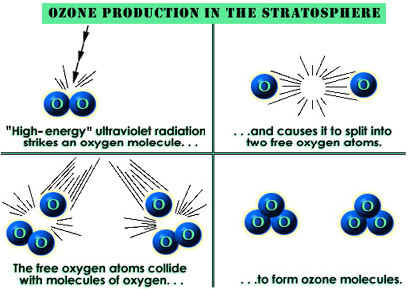
 High in the atmosphere, some oxygen (O2) molecules absorbed energy from the Sun's ultraviolet (UV) rays and split to form single oxygen atoms. These atoms combined with remaining oxygen (O2) to form ozone (O3) molecules, which are very effective at absorbing UV rays. The thin layer of ozone that surrounds Earth acts as a shield, protecting the planet from irradiation by UV light. 
NASA GSFC

The amount of ozone required to shield Earth from biologically lethal UV radiation, wavelengths from 200 to 300 nanometers (nm), is believed to have been in existence 600 million years ago. At this time, the oxygen level was approximately 10% of its present atmospheric concentration. Prior to this period, life was restricted to the ocean. The presence of ozone enabled organisms to develop and live on the land. Ozone played a significant role in the evolution of life on Earth, and allows life as we presently know it to exist. Ozone is produced naturally in the stratosphere when highly energetic solar radiation strikes molecules of oxygen, O2, and cause the two oxygen atoms to split apart in a process called photolysis.
NASA Goddard DAAC

If a freed atom collides with another O2, it joins up, forming ozone O3. Most of the ozone in the stratosphere is formed over the equatorial belt, where the level of solar radiation is greatest. The circulation in the atmosphere then transports it towards the pole . So, the amount of stratospheric ozone above a location on the Earth varies naturally with latitude, season, and from day-to-day.
Credit University Of Alaska
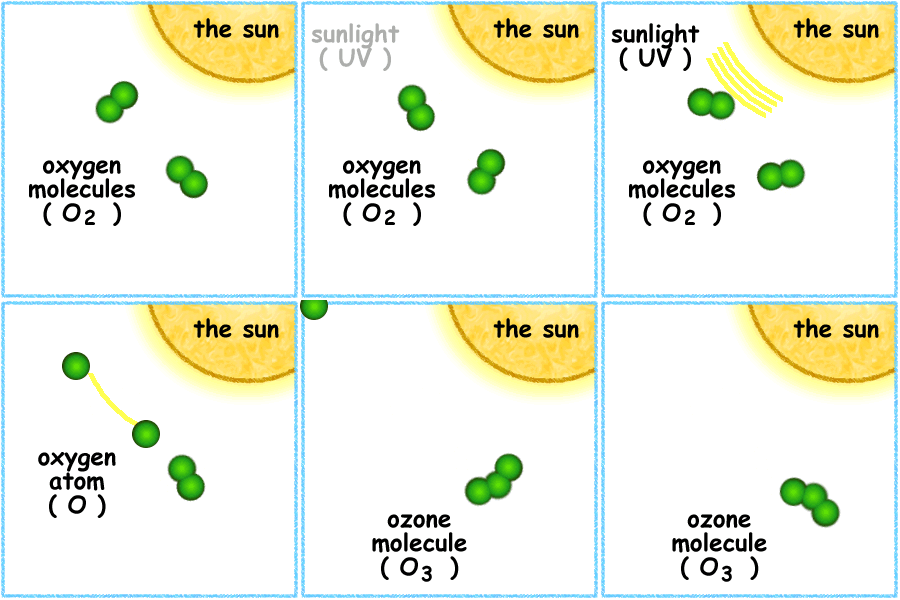
This animation illustrates the formation of ozone. An oxygen molecule (O2) in the stratosphere is broken into 2 oxygen atoms (O + O) by absorbing ultraviolet light energy from the sun. The oxygen atom (O) is now free to react with an oxygen molecule (O2) to create an ozone molecule (O3).

O2 + UV => O + O
O + O2 => O3
Under normal circumstances highest ozone values are found over places such as Canada and Siberia, whilst the lowest values are found around the equator. The ozone layer varies naturally with season. Over Canada is normally about 25% thicker in winter than summer. Weather conditions can also cause considerable daily variations.
Ozone is also naturally broken down in the stratosphere. In an unpolluted atmosphere there is a balance between the amount of ozone being produced and destroyed and so the total concentration remains relatively constant. At different temperatures and pressures (i.e. varying altitudes), there are different production and destruction reaction rates leading to a variation in concentration. The highest ozone concentrations are in the lower stratosphere, between about 18 and 26 km. 
Ozone also occurs in very small amounts in the troposphere. It is produced at ground level through a reaction between sunlight and, e.g., gases emitted from cars. As a pollutant it should not be confused with the separate problem of stratospheric ozone depletion.
Ozone creation and depletion process text-

quinta-feira, 28 de março de 2013

OZONIOTERAPIA NO JORNAL NACIONAL - É HORA DA POPULAÇÃO CONHECER

www.ozone.br.vu
OZONE
http://www.facebook.com/pages/OZONE/630339143649836?fref=ts

ENTREVISTA NO JORNAL NACIONLAR COM DR. GLAUCUS SOBRE A OZONIOTERAPIA


OzônioTerapia Cicatriza Feridas de              DIABETES - Jornal do SBT -

quarta-feira, 27 de março de 2013

MATÉRIA PÚBLICADA NA FOLHA DE SÃO PAULO.MESMO SEM REGULAMENTAÇÃO, MÉDICOS DEFENDEM TERAPIA COM OZÔNIO

Mesmo sem regulamentação, médicos defendem terapia com ozônio

CLÁUDIA COLLUCCI
DE SÃO PAULO
Uma técnica que usa gás ozônio contra infecções, inflamações e dor está criando polêmica no país. Ao menos 200 médicos estão convencidos da sua eficácia e a aplicam em várias doenças.
Mas o CFM (Conselho Federal de Medicina) e a Anvisa (Agência Nacional de Vigilância Sanitária) argumentam que o método, chamado ozonioterapia, não tem amparo científico e, portanto, não pode ser regulamentado.
Nesta semana, um juiz de São Paulo concedeu liminar autorizando um paciente com câncer de um hospital da capital a receber ozonioterapia no peritônio (membrana que reveste as paredes do abdome), como parte do tratamento contra dor.
Há vários estudos na literatura mundial mostrando a eficácia da ozonioterapia_ embora a maioria não seja controlada e tenha baixo grau de evidência científica. A terapia é reconhecida pelos sistemas de saúde de países como Itália, Espanha, Alemanha, Rússia e Cuba.
Os defensores dizem que o método não prospera no país porque contraria interesses da indústria. "Ozônio não é patenteado. Você não engarrafa e vende na farmácia", diz a médica Emília Serra, diretora da Aboz (Associação Brasileira de Ozonioterapia), que tenta há cinco anos regulamentar a prática no país.
O ozônio medicinal pode ser aplicado na corrente sanguínea na veia ou no reto ou diretamente na pele (para tratar feridas). Ele estimula a circulação e a oxigenação de tecidos, com funções bactericida, anti-inflamatória, imunológica e analgésica, segundo Emília.
No Brasil, várias instituições estão pesquisando a técnica. Em 2010, a Universidade de São Paulo, por exemplo, testou a ozonioterapia em bactérias hospitalares multirresistentes a antibióticos. Com apenas cinco minutos de exposição ao ozônio, dez delas foram eliminadas, inclusive a superbactéria KPC, que atingiu 13 Estados e matou ao menos 20 pessoas.
Segundo o médico imunologista Glacus de Sousa Brito, pesquisador responsável pelo ensaio clínico da USP, outras três linhas de projetos de pesquisa com ozonioterapia estão em andamento.
Uma delas propõe o tratamento de feridas infectadas (pé diabético, por exemplo). A outra vai usar o ozônio para desinfetar ambientes hospitalares. A terceira tratará, com o gás, pessoas com infecção hospitalar.
O infectologista Ésper Kallas, professor da USP, diz que, embora os estudos pareçam promissores, é preciso repeti-los em outros centros, para verificar se os resultados permanecem favoráveis. "É necessário provar a reprodutibilidade para que a gente possa empregar no dia a dia", afirma ele.

Editoria de Arte / Folhapress/Editoria de Arte / Folhapress
MINISTÉRIO
No fim do ano passado, a ozonioterapia entrou na pauta do Ministério da Saúde, durante uma audiência pública que recolheu sugestões sobre a incorporação de novas tecnologias no SUS, para o tratamento de feridas.
A Aboz apresentou vários estudos internacionais defendendo que o uso da ozonioterapia poderia reduzir em até 25% os custos do SUS com o tratamento de feridas crônicas e em 80% a taxa de amputação de membros de pacientes com gangrena provocada pelo diabetes.

segunda-feira, 25 de março de 2013

Ozônio e a Máfia dos Laboratórios Milhares de pessoas em Hospitais por causa de infecções, sérios problemas por proliferação de microorganismos acabando com a saúde. Milhares de pessoas nas UTIs, sem que haja necessidade, mais isso, acarreta enormes valores nos bolsos destes mafiosos da saúde.

Ozônio e a Máfia dos Laboratórios


Milhares de pessoas em Hospitais por causa de infecções, sérios problemas por proliferação de microorganismos acabando com a saúde.  Milhares de pessoas nas UTIs, sem que haja necessidade, mais isso, acarreta enormes valores nos bolsos destes mafiosos da saúde.  A dor de seus familiares e ânsia da cura para o ente querido, fica no obscurecimento mental da população por técnicas naturais, baratas e com muito maior resultado. Por causa do que ? Por causa do interesse corporativo e do bolso de poucos, mesmo que estes outros estejam morrendo o que interessa é o dinheiro.   Eu aconselho à anos o uso do Ozônio e agora alguns médicos sérios vêm tentando usar no Brasil. Mais não existe interesse do Ministério da Saúde porque alguém lá de dentro vai perder muito dinheiro.  Segue uma matéria sobre o assunto.      Busquem alternativas elas existem, não aceitem tudo o que lhes digam, a alopatia não é a terapia da cura, mais da pura enganação. 


O gás ozônio (O3), já usado na indústria química e no tratamento de água, ganha espaço em diferentes ramos da medicina. Chamado de ozonioterapia, a técnica usa o gás para tratar inflamações, alergias de pele, infecções agudas, problemas circulatórios e até de imunidade. O problema é que o Ministério da Saúde não reconhece a eficácia do procedimento.

O gás misturado à água, em óleo, ou injetado como vapor em um saco plástico, é aplicado em queimaduras, feridas e na corrente sanguínea com a função de amenizar sintomas.
Uma pesquisa recente da USP (Universidade de São Paulo) mostrou inclusive que o ozônio também é capaz de matar as temidas superbactérias (bactérias resistentes a antibióticos), incluindo a KPC, cuja infecção já atinge 13 Estados brasileiros e matou 20 pessoas.
Especialistas tentam incorporar terapia com ozônio na saúde pública
No Brasil, a técnica é utilizada e defendida por pelo menos 200 médicos que fazem parte da Abroz (Associação Brasileira de Ozonioterapia), mesmo sem apoio do governo. A entidade já fez pedidos recorrentes de inclusão da técnica no SUS (Sistema Único de Saúde).
Segundo a diretora da Abroz, Emília Gadelha, a associação negocia há seis anos para incluir a técnica no sistema público. Para isso, já encaminhou uma série de documentos ao governo que comprovam sua eficácia. O Ministério disse que ainda está estudando a proposta.
A dificuldade de inclusão no país, segundo a diretora da Abroz, se dá pela burocracia e por conflito de interesses.
- É tanta burocracia! Mandamos papéis para o Conselho Federal de Medicina, Conselho Regional de Medicina de São Paulo; fizemos reunião com o Ministério da Saúde. Mas hoje em dia a medicina usa um critério dado pela indústria farmacêutica.
Em dezembro de 2010, o ministério realizou uma audiência pública para reunir essas informações. Ao ser questionado sobre a possibilidade de inserção do tratamento, o ministério respondeu por e-mail.
- Atendendo ao pedido de entidades médicas, o Ministério da Saúde continuará recebendo informações sobre as tecnologias em estudo e apresentadas na audiência pública até o próximo mês de março. Depois do prazo, as considerações serão enviadas à Citec (Comissão de Incorporação de Tecnologia) para análise e decisão. 
O governo não disse até quando vai dar uma resposta. A incorporação de tecnologias no SUS é feita a partir da análise da eficácia, efetividade e custo-benefício dos medicamentos e produtos e deve ser acompanhada de regras precisas quanto à indicação e forma de uso.
De acordo com a diretora da Abroz, o uso do ozônio nesses tratamentos diminuiria custos para o sistema público, pois os resultados são mais rápidos e os equipamentos necessários, segundo ela, não são caros. Um gerador de ozônio (máquina que converte oxigênio em ozônio) pode ser adquirido por R$ 1.000, em média.
- Em termos de saúde pública, acho um desperdício não usar o ozonioterapia. Uma ferida crônica de pé diabético demora de oito meses a dois anos para fechar. Quando médicos cubanos usam o ozônio, demora no máximo dois, três meses. Fora que diminui muito a chance de amputação do membro.
Para Hermelinda Pedrosa, coordenadora do Departamento de Pé Diabético da Sociedade Brasileira de Diabetes, faltam evidências científicas que comprovem a eficácia do ozônio do tratamento das feridas causadas pela doença.
- No meu conhecimento, a ozonioterapia não dispõe de dados científicos robustos que dizem que a medida traga um efeito positivo. Não é uma ferramenta consensual no campo científico.
Combate à superbactéria não é consenso
Outro ponto que divide os médicos é a ação antibacteriana do ozônio. O imunologista Glacus de Souza Brito, do Departamento de Imunologia da USP (Universidade de São Paulo) demonstrou o poder do gás em eliminar superbactérias.
Um ensaio clínico realizado por ele no Hospital das Clínicas de São Paulo, no Departamento de Cirurgia de Trauma, conseguiu eliminar dez tipos de bactérias hospitalares multirresistentes aos antibióticos com apenas cinco minutos de exposição ao gás. Uma das cepas estudadas foi a KPC.
- Seria uma formas de tratar a KPC, mas estamos ainda montando o estudo que tem que ser aprovado no Comitê de Ética da USP.
Dada a aprovação, o estudo precisa ainda ser liberado pelo Comitê de Ética Médica Nacional e pela Anvisa (Agência Nacional de Vigilância Sanitária) para ser usado em seres humanos.
Se o procedimento indicado for aceito, terá como método a “ozonização do sangue”, ou seja, será retirada uma amostra de sangue que será misturada ao ozônio e reinjetada na corrente sanguínea. O imunologista diz que o procedimento é seguro.
- Não tem efeito colateral, porque depois que o ozônio entra no corpo vira oxigênio em alta concentração, que funciona como um medicamento.
O infectologista Carlos Magno Fortaleza, professor da Faculdade de Medicina da Unesp (Universidade Estadual Paulista), no entanto, não reconhece a eficácia da ozonioterapia para tratar superbactérias. 
- Nunca usei para tratar infecção por bactéria multirresistente e nunca ouvi falar sobre a real eficácia do ozônio em tratamentos infectocontagiosos.
http://projetonovasonorum.blogspot.com.br/2011_04_01_archive.html